
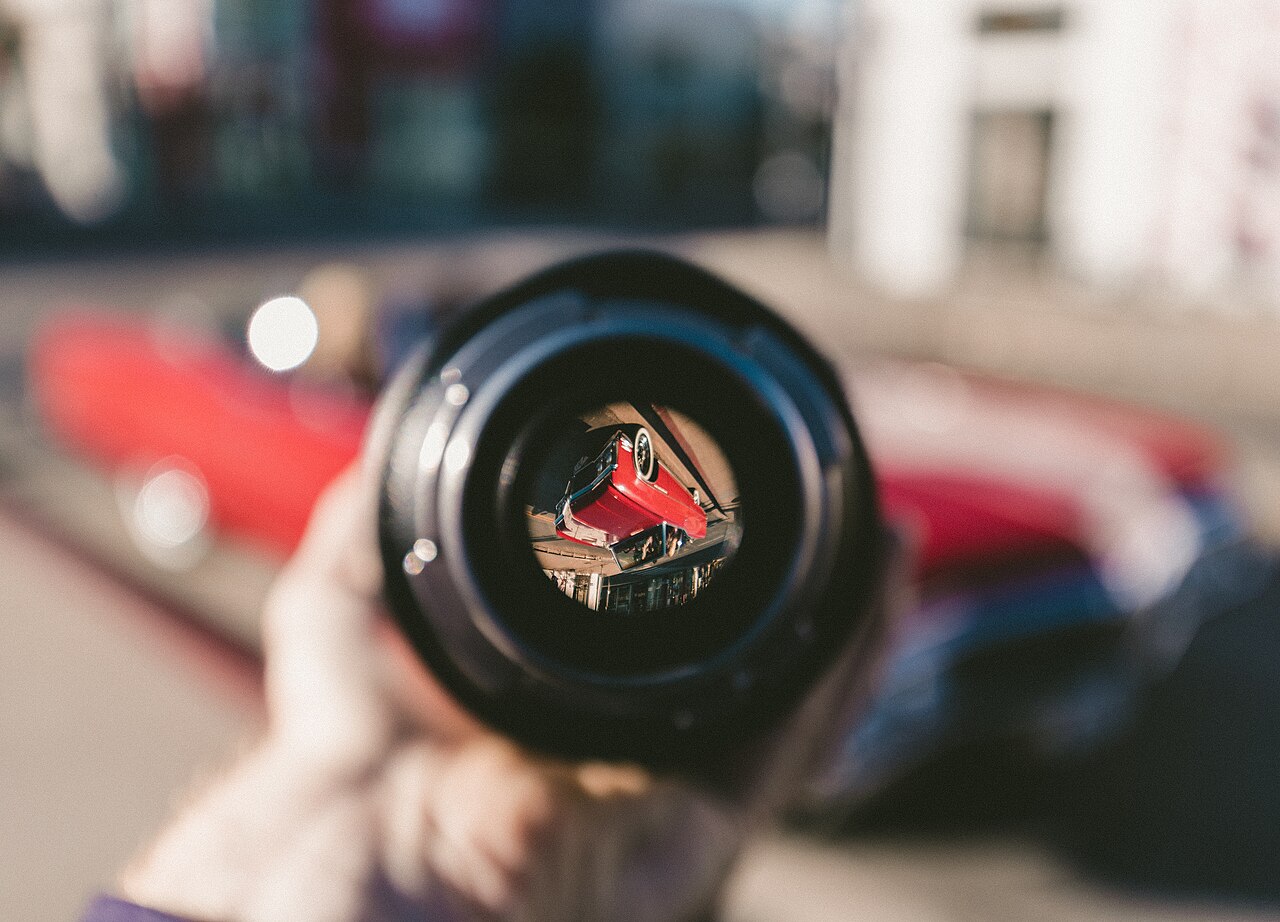
Depth of field decides how much of your photo looks sharp and how much melts into blur. Here is what controls it and how to use it on purpose.
This guide is general information for creators and businesses in the U.S., not legal advice. Copyright, licensing and drone rules depend on the facts and change over time; check the Copyright Office, the FAA or a lawyer for your situation.
Quick notes
- Depth of field is the zone in front of and behind your focus point that still looks acceptably sharp.
- A low f-number like f/2.8 means a wide aperture, less depth of field and a blurrier background; a high f-number like f/11 means the opposite.
- Getting closer to your subject shrinks depth of field, and longer focal lengths blur backgrounds more at the same aperture.
- Shallow depth of field isolates a product or person; deep depth of field keeps every detail sharp from front to back.
- You can get background blur cheaply by moving your subject away from the background and getting close yourself.
Look at two photos of the same product on the same table. In one, everything from the item to the wall behind it is sharp. In the other, the product is crisp and the background melts into soft blur. Depth of field is the difference, and once you know what controls it, you can choose the look instead of hoping for it.
What Depth of Field Actually Means
Depth of field is the zone of acceptable sharpness in a photo, extending in front of and behind the point you focused on. A lens can only focus sharply at one distance. Everything else falls off gradually, but there is a range around that focus point that still looks sharp enough to most viewers.
Photographers call a small zone shallow and a large zone deep. Shallow means blur starts soon after your subject; deep means the scene stays sharp front to back. Neither is better; they are tools for different jobs.
Aperture and the F-Number: Small Number, Blurrier Background
Aperture is the opening in your lens that lets light reach the sensor, measured in f-stops like f/2.8, f/5.6 or f/8. The numbering runs backwards from what most people expect. A low f-number means a wide opening that lets in more light; a high f-number means a small opening that lets in less.
The same relationship governs sharpness:
| Setting | Opening | Depth of field | Typical use |
|---|---|---|---|
| f/1.8 to f/2.8 | Wide | Shallow, blurry background | Portraits, isolating a subject |
| f/8 to f/11 | Small | Deep, sharp throughout | Wide scenes, detail front to back |
| f/16 to f/22 | Very small | Very deep | Video, everything in focus |
So f/2.8 gives the blurry-background portrait look, while f/8 or f/11 keeps detail across the frame. Aperture also affects brightness, so stopping down in a dim room costs shutter speed. Aperture Priority mode lets you pick the f-number while the camera handles shutter speed, and our guide to shooting in manual mode covers the whole balancing act.
Studio tip: Start in Aperture Priority if your camera has it. You pick the f-number and the camera handles shutter speed.
Why Your Distance From the Subject Matters
Aperture is not the only control. The closer you are to your subject, the shallower the depth of field, and the change is not proportional: it shifts with the square of the distance, which is why close-range photos keep so little in focus. Even stopped down, a tight close-up may hold only a thin slice sharp.
A worked example, as an illustration. Photograph a candle on a table. From three feet away at f/4, the candle and a good chunk of the table around it are sharp. Move in to eight inches to fill the frame with the label, and at the same f/4 the front of the label may be sharp while the back edge goes soft. You did not touch a dial. Distance alone shrank the depth of field, and backing up or stopping down gets it back.
Focal Length and Background Blur
Focal length, measured in millimeters, describes a lens’s angle of view and magnification. Longer focal lengths magnify more, and greater magnification means shallower depth of field: at f/4 from ten meters, 24mm gives far more depth of field than 200mm.
This is why portraits taken with longer lenses get that soft background so easily, and why the wide lens on a phone makes blur harder. Sensor size plays a role too: at the same aperture, larger sensors produce shallower depth of field than smaller ones, which is another reason dedicated cameras blur backgrounds more readily.
When Blur Helps and When Sharpness Wins
Shallow depth of field directs attention. A blurred background removes distractions you cannot physically move. For products, it works best when the item has depth or sits in a real environment: a coffee bag on a cafe counter, a handmade item with the workshop softly behind it. The product stays sharp while the surroundings stop competing.
But blur is not automatic praise. For flat products, packaging shots and anything sold by its details, blur can hide information a buyer needs. And a clean sheet of paper behind the product leaves nothing to blur anyway.
Deep depth of field is right whenever detail across the frame is the point. Wide scenic shots, room interiors, large group photos and architectural shots benefit from a small aperture like f/8 or f/11 so foreground and background both hold up. Product photography leans this way too when a buyer needs to read a label. Stop down far enough in dim light that shutter speeds slow, and put the camera on a tripod.
Getting Blur Without an Expensive Lens
Fast prime lenses with wide maximum apertures around f/1.8 produce lovely blur, but they are not the only route. Before spending money, try these:
- Move your subject well away from the background. Distance between subject and background makes that background look more out of focus.
- Get close to your subject yourself. The closer you focus, the shallower the depth of field.
- Use the longest focal length you have. Step back and zoom in for the same framing; the magnification softens the background.
- Shoot wide open. Set the lowest f-number your lens allows in good light.
Phones follow the same logic. Small sensors and wide lenses work against you, but a subject a few feet from the background, shot close, will still separate. Depth of field is a set of distances and settings, not a price tag.
To put this to work, our guide to product photos with a phone shows a setup where a plain background does the isolating, and buying a tripod covers the gear that keeps deep-focus shots sharp.
FAQs
Does a lower f-number always blur the background more?
At the same distance and focal length, yes. A lower f-number means a wider lens opening, which produces a shallower depth of field and a blurrier background.
Can I get a blurry background with a phone camera?
Sometimes. Phones have small sensors and wide lenses, which give deep depth of field, so the most reliable method is to get close to your subject while keeping it far from the background.
What aperture should I use for product photos?
It depends on the product. Flat items like framed prints can be shot sharp front to back, while a bottle or box with depth often looks better with enough depth of field that the whole product is sharp and only the background softens.
Why do my close-up shots have almost no depth of field?
Depth of field shrinks quickly as you get close to a subject, so at very near distances even a stopped-down lens may keep only a thin slice in focus.