
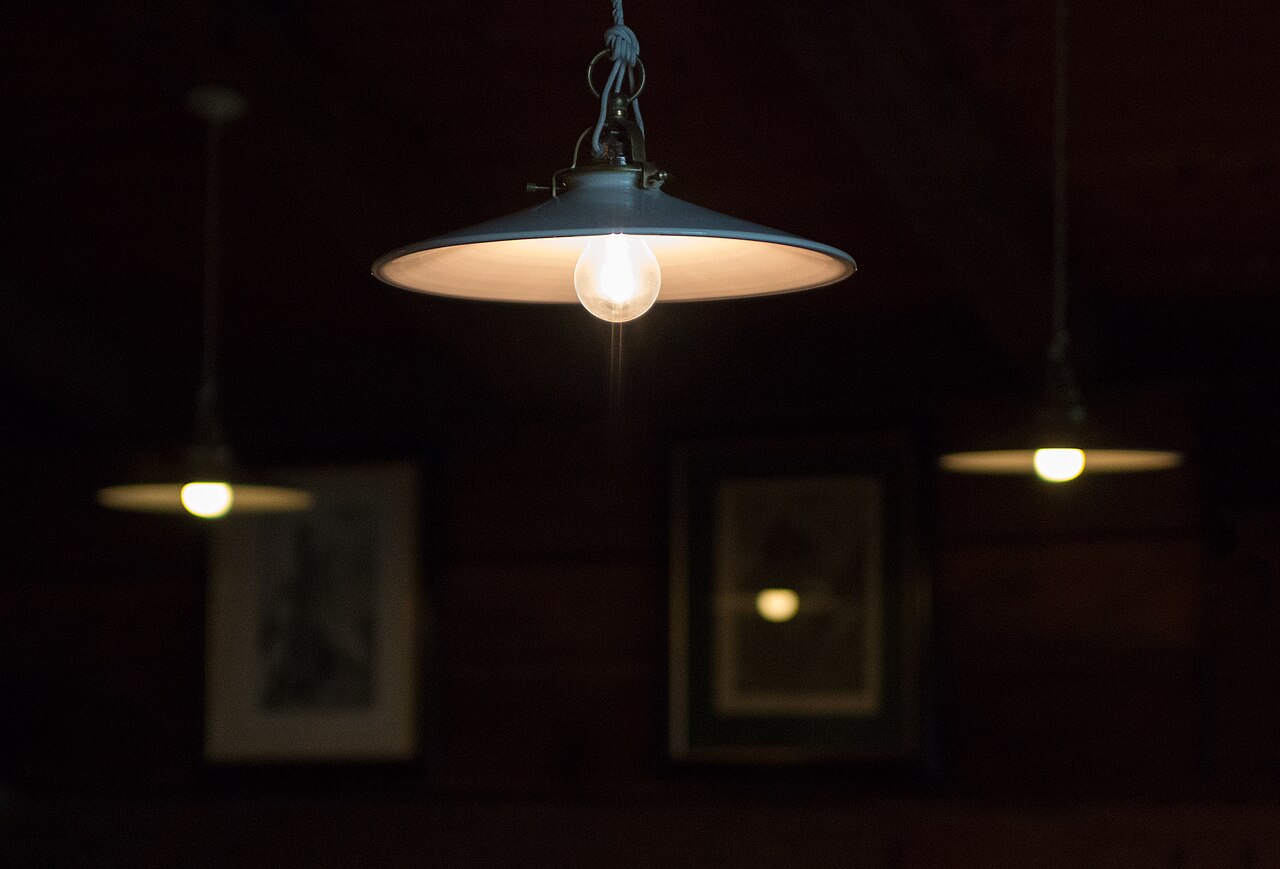
Five lighting setups built from floor lamps, desk lamps and daylight, plus the color temperature basics that keep your footage from turning orange.
This guide is general information for creators and businesses in the U.S., not legal advice. Copyright, licensing and drone rules depend on the facts and change over time; check the Copyright Office, the FAA or a lawyer for your situation.
Quick notes
- Any household lamp can serve as a key, fill or backlight; direction and color temperature matter more than what the lamp cost.
- Bulbs run warm white (about 2000K to 3200K), neutral white (4000K to 4500K) and cool white to daylight (5000K to 6500K), so match them in one scene.
- A lamp bounced off the ceiling or a white card becomes a larger, softer source than one pointed straight at the subject.
- A lamp behind and above you separates you from the wall and adds depth to talking head shots.
- Mixing a warm bulb with window daylight splits footage into orange and blue, so pick one source or match your bulbs.
You do not need to buy a single light to record a decent talking head video or product demo. Most homes already hold everything a small lighting kit needs: a floor lamp, one or two desk lamps and a window. This article walks through five setups built entirely from lamps you already own, plus a few small adjustments that make any of them look better.
What Makes a Lamp Useful as a Video Light
Professional video lighting usually follows a three-point setup: one main light called the key, a softer light on the opposite side called the fill, and a light above and behind the subject called the backlight. Any household lamp can fill one of those roles.
Two things decide whether a lamp helps or hurts. The first is direction, meaning where the light lands on your face or product. The second is color temperature, measured in Kelvin. Warm white bulbs run from about 2000K to 3200K and give off a yellowish glow, the kind used in restaurants for a cozy feel. Neutral white sits around 4000K to 4500K, a balanced light common in offices. Cool white to daylight bulbs, 5000K to 6500K, put out a bluish light close to actual daylight and are the standard choice for video production. Cameras expect one color temperature at a time, so matching your bulbs matters more than how bright they are.
Idea 1: The Key Light From a Floor Lamp
A floor lamp makes a solid key light, the main source that gives your face shape on camera. Place it on one side of you, a few feet away and at or slightly below camera height, and sit so the light crosses your face at an angle instead of hitting it square on. In a standard setup the key sits to one side of the subject and below the camera, which produces gentle modeling rather than the flat look a bare ceiling fixture gives.
Leave the shade on for talking head shots. It softens the bulb and spreads the light across more of your face. If the light feels too dim, move the lamp closer before you reach for a brighter bulb. The nearer a light sits to your subject, the larger it is from the camera’s point of view and the softer its shadows.
Idea 2: Bouncing a Desk Lamp Off the Ceiling
A desk lamp aimed straight at you is a small, hard source that carves shadows into your eye sockets. Aimed at the ceiling or a white wall, the same lamp becomes a much larger and softer one, because the ceiling itself turns into the surface your subject sees. The only thing you changed was the angle.
Bouncing works at close range too, as a way to fill shadows. If one side of your face sits dark, prop a piece of white card stock, a pizza box or a sheet of aluminum foil so it catches light from your lamp or window and throws it back. Silver surfaces like foil produce a strong, bright fill, while white surfaces give a softer, more natural one. Watch the shadow side of your face as you adjust the card; small changes in angle do more than people expect.
Idea 3: A Back Light to Separate You From the Wall
Footage of a person against a bare wall tends to look flat, with subject and background melting together. A second lamp placed behind you, raised above head height and aimed at your shoulders and the back of your head, fixes it. Standard three-point setups put the backlight above and behind the subject for exactly this reason: it draws a bright edge between you and the background and adds depth to the frame.
A floor lamp suits this job because it stands on its own behind you, out of frame. You want a rim of light, not a glare in your eyes.
The same principle explains a common mistake. Sit with a bright window behind you and the window becomes a giant backlight, leaving your face dark. Turn your chair around so the window lights your face instead.
Idea 4: The Tabletop Setup for Product Close-Ups
Product demos need light that falls evenly across a small area, and two desk lamps plus a sheet of white foam board will get you there. Lay the foam board on the table and set the product on it. The board does double duty as a smooth, uncluttered surface and as a reflector that bounces light up into the underside of the product, which is where tabletop shots usually go muddy.
Put one lamp to the side of the table at roughly a 45 degree angle, and use the second lamp or a white card from the opposite side to fill the shadows. Tilt the camera down to frame the shot. If a highlight blows out on a glossy surface, pull the lamp back or soften it with a white bounce card on the shadow side. More household diffuser options are covered in our guide to diffusing harsh light with household items.
Shoot a short test clip before the real take and review it on a screen larger than your phone.
Idea 5: Mixing Lamps With Daylight Without Going Orange
Window daylight is the cheapest flattering key light there is, and it can work as your fill too when a lamp is the brighter source. Shoot in the morning by an east-facing window and in the late afternoon by a west-facing one, and you get soft, angled light instead of harsh direct sun.
The catch is color. A warm bulb at around 3200K sitting next to daylight at 5600K will split your frame in two: the lamp side of your face turns orange while the window side turns blue. The fix is to choose one source. Either swap every bulb in the frame for a daylight-colored bulb so the lamps match the window, or close the curtains and go all lamp. Then set the camera’s white balance to match, and the footage should look even straight out of camera. If your indoor photos have ever come home orange, this mismatch is usually the reason, which we explain more fully in why indoor photos look orange.
Small Tweaks: Dimmers, Distance and Diffusers
A few adjustments get more out of any of the setups above:
- Distance. Moving a lamp closer makes it brighter and, relative to the subject, larger and softer. Pulling it back evens the light across a wider area but flattens it.
- Dimmers. If a lamp has one, use it to balance the key against the fill instead of rearranging furniture.
- Diffusers. A sheer white curtain or a translucent white shower curtain softens harsh sun through a window. Parchment paper taped a hand’s width from a bulb does the same for a lamp.
- Test clips. Record ten seconds after every change and watch it back before committing to a full take.
Studio tip: Before you rearrange anything, check the bulbs in the shot. Two bulbs of different color temperatures will fight each other no matter how well you place the lamps, so matching bulbs is the fastest fix on this list.
Once the lamps are placed, a quick pass through our pre-shoot lighting checklist catches the details most people miss. And if the footage still looks a little off afterward, our piece on whether your video really needs color grading explains what editing can fix and what it cannot.
FAQs
Can I use regular household bulbs for video?
Yes. What matters is that every bulb in the shot shares the same color temperature and that the light lands from a flattering angle. For general guidance, video production most often uses cool white to daylight bulbs in the 5000K to 6500K range.
How many lamps do I need for a talking head video?
Two will do: one as your key light to one side and one as a fill or backlight. Even a single floor lamp angled across your face beats a bare ceiling fixture.
Why does my video look orange when I use lamps?
Warm bulbs give off yellowish light, and if the camera expects daylight the whole frame shifts orange. Match the white balance setting to your bulbs, or swap in daylight-colored bulbs.
Do I need to buy a softbox?
No. A lampshade, a bounced ceiling or wall, a white bounce card or a sheer curtain over a window all soften light using things you already have.